
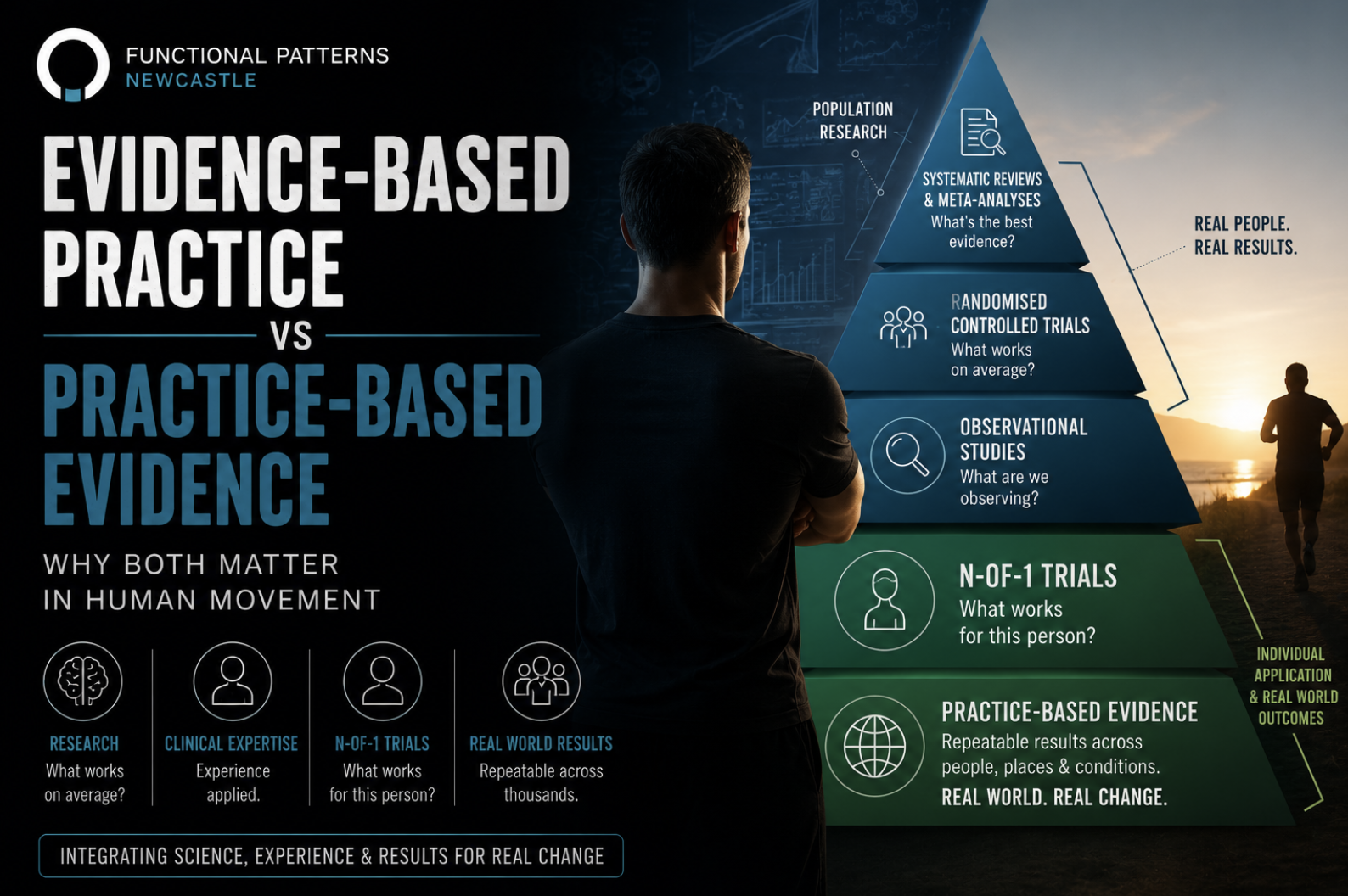
Evidence-Based Practice has transformed healthcare.
Without it, rehabilitation would still rely heavily on tradition and opinion.
But somewhere along the way, many clinicians began equating Evidence-Based Practice with one thing:
Published research.
That was never the original intention.
Evidence-Based Practice was developed to integrate three equally important components:
These three pillars work together.
Research alone was never intended to dictate every clinical decision.
Randomised Controlled Trials are excellent for testing simple questions.
Does intervention A outperform intervention B?
Does changing one variable influence another?
But human movement, and physiology isn't simple.
Pain is influenced by:
Biomechanics.
Psychology.
Stress.
Sleep.
Breathing.
Learning.
Previous injuries.
Environment.
Physical capacity.
These variables interact continuously.
Yet research must deliberately reduce complexity in order to study it.That's both its strength and its limitation.
Many rehabilitation studies exclude participants with:
Researchers need controlled populations.
Clinicians work with real people.
Most clients arrive with several interacting problems that can't be separated into neat experimental groups.
Imagine helping someone with chronic lower back pain.
Would changing only one variable be enough?
Or would lasting improvement require changes in:
Real rehabilitation often requires multiple changes occurring together.
That's difficult to study in an RCT.
But it's everyday clinical practice.
Interestingly, Gordon Guyatt—the physician who coined the term Evidence-Based Medicine—has recently argued that well-designed N-of-1 trials deserve to sit at the top of the evidence hierarchy for individual patient care.
Why?
Because research tells us what tends to work for groups.
An N-of-1 trial tells us what actually works for the individual standing in front of us. Ultimately, that's the question every client cares about.
Functional Patterns is built around this idea.
Every client becomes an ongoing N-of-1 trial.Movement is assessed.
An intervention is applied.
The response is measured.
The programme evolves.
This process has now been repeated across thousands of people from vastly differentbackgrounds:
Children.
Older adults.
Athletes.
Parents.
Office workers.
People with knee pain.
Lower back pain.
Shoulder pain.
Movement limitations.
Neurological conditions.
Across countries, cultures and demographics, remarkably consistent bio-mechanical principles continue producing repeatable results.
That's what Practice-Based Evidence looks like.
At Functional Patterns, research isn't ignored.
It's placed within a broader framework.
Everything begins with first principles.
Human evolution.
Gravity.
Force transmission.
Walking.
Adaptation.
Research investigates those principles.
Clinical reasoning applies them.
Practice-based evidence demonstrates whether they continue working in the complexity of real life.
The future of rehabilitation doesn't belong to research alone.
Nor does it belong to anecdote alone.
It belongs to systems capable of integrating:
That's the philosophy underpinning Functional Patterns.
Not choosing between science and experience.
But recognising that lasting human change requires both.
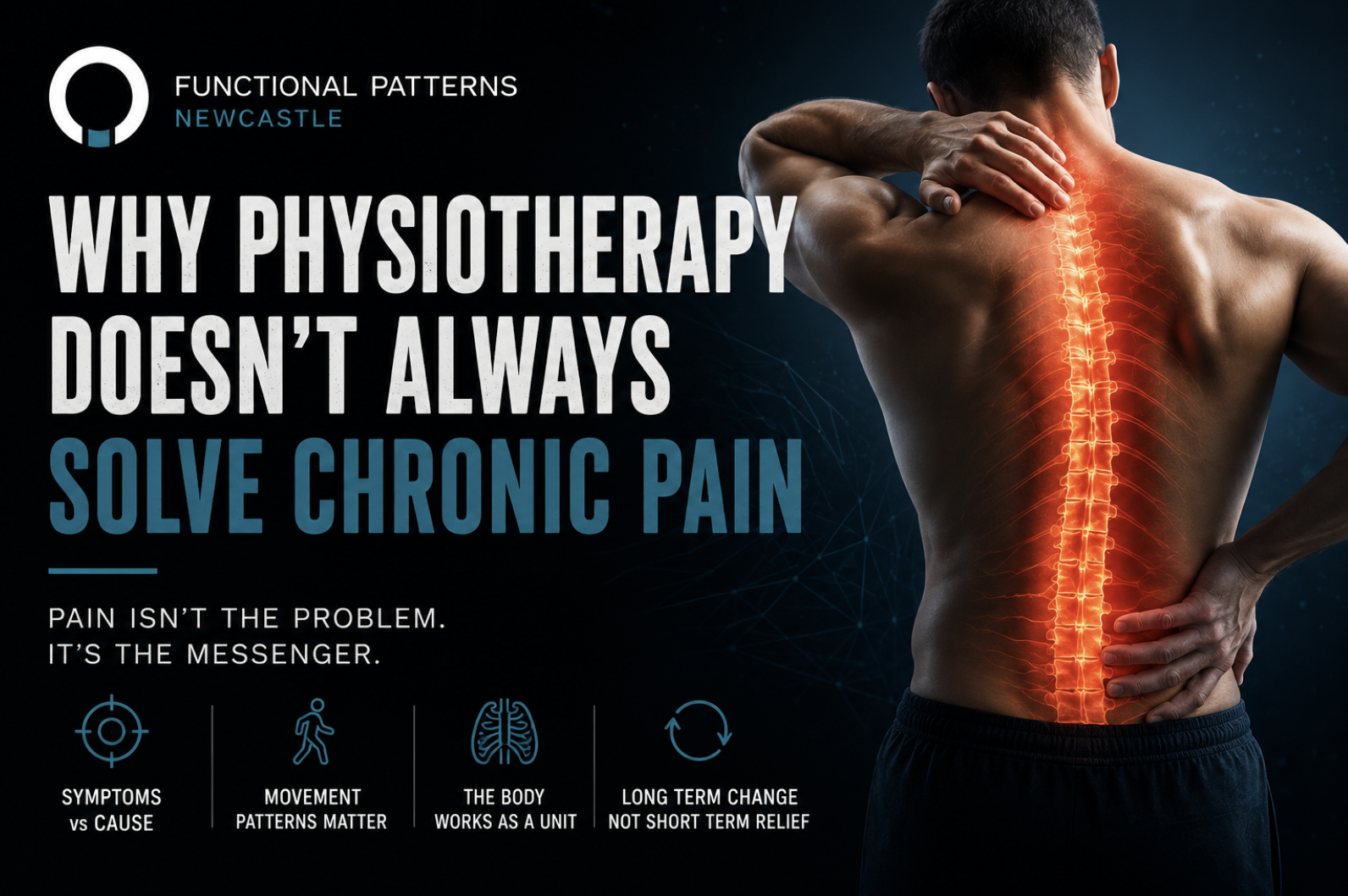
One of the most frustrating experiences for people living with chronic pain is this:
Treatment works.
The pain improves.
Life goes back to normal.
The weeks or months later...The pain comes back.
For many people, this cycle repeats for years.
Massage.
Dry needling.
Stretching.
Strengthening.
Manual therapy.
Each intervention provides temporary relief, yet the underlying problem never seems to disappear.
Why?
Because many rehabilitation approaches are excellent at identifying where pain is occurring,but less equipped to answer the more important question:
Why is this tissue being overloaded in the first place?
Contemporary physiotherapy has helped millions of people recover from injuries.
Whether it's an irritated tendon, a strained muscle, a painful shoulder or a disc injury, physiotherapists are highly trained to identify damaged or overloaded structures and guide recovery.
This approach is invaluable.
Painful tissues deserve attention.
Reducing pain matters.
Improving function matters.
But for persistent pain, identifying the painful tissue is often only the beginning.
The body doesn't function one joint at a time.
Every step you take involves your feet, pelvis, rib cage, spine, breathing, nervous system and muscles working together.
When one area stops contributing effectively, another area often compensates. Eventually, that compensation becomes overloaded.
The place that hurts is frequently the place doing the most work—not necessarily the place creating the problem.
Chronic lower back tightness is a common example. Most people attempt to treat the lower back directly.
They stretch it.
Massage it.
Strengthen it.
Foam roll it.
Needle it.
Sometimes these treatments help. But often only temporarily.
Why?
Because the lower back is frequently compensating for inefficient mechanics elsewhere.
If the pelvis and rib cage don't coordinate well during standing and walking, the lumbar spineoften increases muscular tension to provide stability.
The nervous system isn't creating tension by accident. It's solving a mechanical problem.
Until that problem changes, the tension usually returns.
Many rehabilitation approaches naturally focus on reducing symptoms. That's understandable.
Pain affects quality of life.
But reducing symptoms doesn't automatically change the forces travelling through the bodyevery day.
If posture, gait, breathing and force distribution remain unchanged, the same tissues often continue experiencing the same stress.
The result?
Temporary improvement. Followed by recurring pain.
Functional Patterns begins with a different question.Instead of asking:
"How do we calm down this painful tissue?"
The question becomes:
"Why has this tissue become overloaded?"
Rather than viewing the body as isolated joints and muscles, Functional Patterns assesseshow the entire system organises movement.
That includes:
When these relationships improve, excessive stress on painful tissues often reduces naturally.
The goal isn't simply to remove pain.
It's to remove the reason the pain developed.
Pain is often viewed as something to eliminate.
Functional Patterns views pain differently.
Pain is information.
It tells us that the body is struggling to manage load somewhere within the system.The objective isn't simply to silence the message.
It's to understand why the message exists.
Physiotherapy still has some utility in healthcare.
Acute injuries, post-operative rehabilitation, acute pain management.
These all play an essential role.
But when pain becomes persistent, the conversation often needs to expand beyond the painful tissue itself.
Long-term change usually requires improving the mechanics that created the overload in the first place.
Because when the body no longer needs to compensate...It often no longer needs to produce pain.
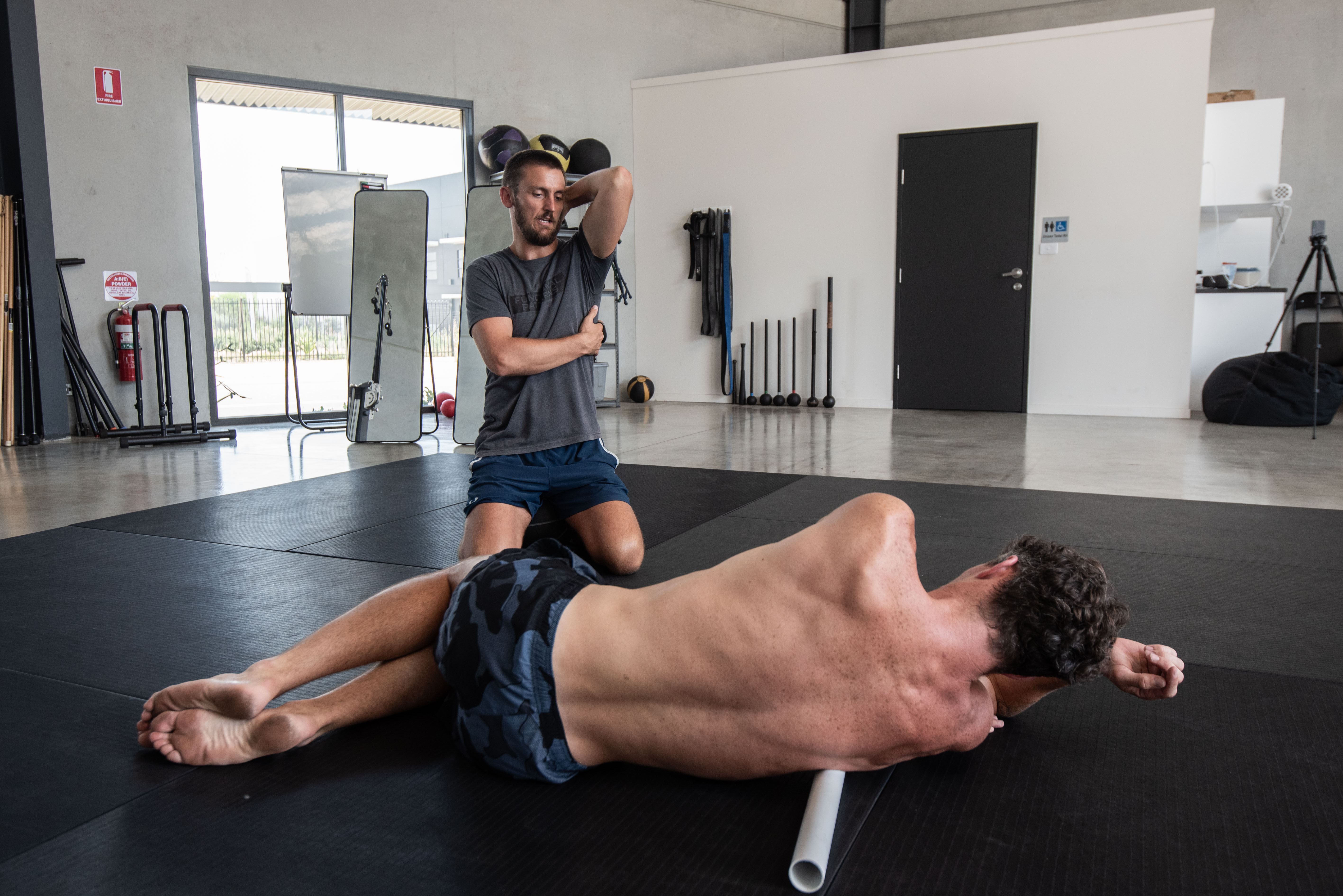
Walk into almost any gym, recovery centre or scroll through social media and you'll
see foam rollers, massage balls, percussion guns and "myofascial release" (MFR)
techniques being promoted as the solution to pain, stiffness and recovery.
Recovery is a big part of the fitness and rehab industry. From elite athletes to office
workers, people are investing more time than ever into recovering from training, work
and the physical demands of modern life.
But is myofascial release really "breaking up knots" or "releasing tight muscles"?
The answer is more nuanced than most people would believe.
There are good reasons why MFR has exploded in popularity.
Modern lifestyles involve prolonged sitting, repetitive movement patterns, high stress
levels and arbitrary exercise modalities that humans didn’t evolve for. People feel
stiff, sore and restricted, so naturally they're searching for something that provides
immediate relief.
Myofascial release often does exactly that.
Whether it's foam rolling before the gym or lying on a massage ball after work, many
people experience reduced tension, easier movement and temporary pain relief
within minutes.
The problem isn't that MFR doesn't work.
The problem is that many people misunderstand why it works.
You'll commonly hear claims that MFR:
● Releases tight muscles
● Breaks up scar tissue
● Removes adhesions
● Breaks apart muscle knots
● Lengthens fascia
These explanations sound intuitive, but the evidence supporting them is surprisingly
limited.
The amount of force you can generate with a foam roller or massage ball is nowhere
near enough to permanently remodel healthy fascia or physically "break apart" tissue
in the way it's often described.
If that were true, we'd likely cause tissue damage every time we rolled.
While MFR does have some mechanical benefits, current evidence suggests that the
benefits are primarily neurological.
Instead of physically changing the tissue itself, MFR appears to:
● Improve local circulation and fluid dynamics
● Reduce protective muscle guarding
● Improve body awareness (proprioception)
● Produce short-term improvements in range of motion
● Temporarily reduce nervous system tone
Think of it like turning the volume down on your nervous system rather than
changing the structure of your body.
Your muscles haven't suddenly become longer.
Your system is just more primed for better movement.
For this reason, MFR can be an incredibly useful tool—but only when used
appropriately.
At Functional Patterns Newcastle, we view myofascial release as exactly that:
A tool—not a solution.
Tension rarely develops randomly.
Your body creates tension for a reason.
Often it's attempting to stabilise poor mechanics elsewhere in the system.
Imagine someone who constantly experiences a tight lower back.
They spend every evening lying on a foam roller or massage ball, temporarily
relieving the discomfort.
The next morning the tightness is back.
Why?
Because the lower back wasn't the problem.
It was the compensation.
If the pelvis sits excessively forward while the rib cage remains flared, the lumbar
spine often becomes the area responsible for creating stability.
The body maintains increased tone there because it has no better option.
Until the relationship between the pelvis, rib cage and the rest of the body improves
through addressing the FP BIg 4, standing, walking, running and throwing, the
tension will remain the same.
The release wasn't wrong.
It simply wasn't followed by a solution.
Used strategically, MFR can be extremely valuable.
Before Movement
Reducing unnecessary muscle tone before introducing better movement patterns
can make it easier for the body to adapt and sustain the new inputs.
You're essentially creating a window of opportunity where the nervous system is
more receptive to change.
As a Recovery Tool
After a physically demanding day or intense training session, MFR can help shift the
body toward a more relaxed state.
Many people find it useful in the evening to help reduce overall nervous system
arousal before sleep.
To Improve Body Awareness
Sometimes people can't control a body part simply because they can't feel it well.
Targeted myofascial release can increase sensory awareness, making it easier to
access muscles and positions that previously felt disconnected.
Problems arise when MFR becomes the only strategy.
If you're rolling the same calf, hip flexor, neck or lower back every day for
months—or years—you should ask yourself an important question:
Why does it keep getting tight?
If nothing changes after the release, your body is simply returning to the same
mechanical solution.
The body is doing exactly what it's designed to do.
It recreates the tension because the underlying movement problem still exists.
In these situations, MFR becomes less of a rehabilitation strategy and more of a
temporary pain-management routine.
It feels good.
But it doesn't create lasting change.
This is where many rehabilitation and recovery programs fall short.
The release is only the first step.
The next—and arguably most important—step is integration.
Integration means teaching your body how to move as an interconnected system.
The way we do this is respecting how the human body evolved to move - by
prioritising standing, walking, running and throwing.
Rather than allowing old movement habits to return, you reinforce more efficient
biomechanics through intentional movement.
At Functional Patterns Newcastle, we often use myofascial release before movement
sessions—not because we expect it to permanently solve the issue, but because it
creates a better environment for making new connections.
The goal isn't simply to feel looser.
The goal is to earn the right to keep those improvements by improving the way your
body organises itself during standing, walking, running and everyday movement.
Myofascial release deserves its place in modern recovery.
It can reduce muscle tone, improve body awareness, increase short-term mobility
and help regulate the nervous system.
But it shouldn't become a substitute for improving how you move.
If the mechanics that created the tension remain unchanged, the tension will almost
always return.
Use release as an initial starting point.
Then use movement to create lasting change.
That's where long-term resilience is built.

As a physiotherapist, this might sound like a strange thing for me to say.
But after working with hundreds of people dealing with persistent pain, I've noticed the same
pattern over and over again.
Many people have already seen multiple physiotherapists.
They've had hands-on treatment.
They've completed strengthening exercises.
They've stretched.
They've dry needled.
They've taped.
They've followed the rehabilitation plan.
Sometimes they even improve.
But a few weeks or months later...
The pain comes back.
So why?
Modern physiotherapy is excellent at identifying local tissue pathology.
A sore Achilles tendon.
An irritated rotator cuff.
Patellofemoral knee pain.
Lumbar disc irritation.
Hip impingement.
Tennis elbow.
Most physiotherapists are highly trained to determine which tissues are irritated and
prescribe treatments aimed at reducing pain and improving function.
That skill is incredibly valuable.
But here's the question that often isn't fully answered:
Why did that tissue become overloaded in the first place?
Pain is often the end result of a mechanical problem—not the beginning of one.
Think about a car.
If one tyre keeps wearing out faster than the others, replacing the tyre solves the immediate
problem.
But if the wheel alignment hasn't changed, the new tyre wears out exactly the same way.
The tyre wasn't defective.
It was responding to the forces being placed upon it.
Your body behaves similarly.
Muscles, tendons, ligaments and joints adapt to the loads they experience every single day.
When those loads become consistently abnormal, tissues eventually become irritated.
The tissue isn't always the cause.
It's often the victim.
One of the most common presentations we see is persistent lower back tightness.
Many people have spent years trying to release it.
Massage.
Foam rolling. (Link to MFR Blog)
Dry needling.
Stretching.
Core exercises.
Manual therapy.
Each intervention provides relief.
But only temporarily.
Why?
Because the lower back is often compensating for poor organisation elsewhere.
If the pelvis remains tipped forward while the rib cage sits elevated and the thorax struggles
to rotate efficiently during walking, the lumbar spine frequently becomes responsible for
creating stability.
The nervous system increases muscle tone there because it has no better option.
Treat the lower back all you want.
If those relationships never improve, the tension returns.
Not because the treatment failed.
Because the body is still solving the same mechanical problem.
Most rehabilitation focuses on reducing pain.
And that's important.
Pain limits movement.
Pain changes behaviour.
Pain affects quality of life.
But reducing pain doesn't automatically change the mechanics that produced it.
This is why many people find themselves in a cycle:
Pain develops.
Treatment reduces symptoms.
Life returns to normal.
The same movement patterns continue.
Pain gradually returns.
The cycle repeats.
Functional Patterns starts from a different question.
Instead of asking:
"How do we calm down this painful tissue?"
We ask:
"Why is this tissue being overloaded every single day?"
That changes everything.
Rather than isolating a painful body part, we assess how your entire body distributes force
through:
● Breathing
● Standing posture
● Walking gait
● Rib cage and pelvis relationship
● Rotation through the trunk
● Foot mechanics
● Weight transfer
Because that's how your body actually functions.
As one integrated system.
When these relationships improve, the excessive stress being placed on the painful area
often reduces naturally.
As both a physiotherapist and a Functional Patterns practitioner, I've found that the greatest
long-term improvements come from combining an understanding of pain with an
understanding of biomechanics.
It's not enough to know what's hurting.
We also need to know why it's happening.
Pain isn't always something to eliminate.
Sometimes it's information.
It's your body's way of telling you that the forces travelling through your system aren't being
managed efficiently.
Our goal isn't simply to make the pain disappear.
Our goal is to improve the mechanics that led to the pain in the first place.
When you change the inputs your body experiences every day—standing, walking, bending,
rotating and breathing—you change the loads placed on your tissues.
And when those loads change, the need for chronic compensation often changes too.
That's where long-term results begin.
If you've had treatment that helped temporarily but the pain keeps returning, it may be time
to look beyond the painful tissue itself.
At Functional Patterns Newcastle, our Initial Assessment examines how your entire body
functions as a system. We'll identify the movement compensations contributing to your pain
and build a plan that addresses the root mechanical cause—not just where the symptoms
happen to show up.

If you’re searching for Functional Patterns training in Australia, this guide will help you find a certified Functional Patterns facility near you.
Whether you’re dealing with chronic pain, poor posture, recurring injuries, or simply want to move and perform better, Functional Patterns offers a system designed to improve how the body functions as a whole.
At Functional Patterns Newcastle, we help clients improve posture, gait, movement efficiency, and overall resilience through a structured approach focused on long-term results — not temporary symptom management.
Functional Patterns Official Website
Functional Patterns is a training methodology that focuses on restoring natural human movement patterns. Instead of isolating muscles or chasing short-term fitness goals, the system aims to improve the way the body operates as an integrated unit.
The main areas of focus include:
The goal is to create a body that moves more efficiently, experiences less pain, and performs better in everyday life and sport.
Located in Newcastle, NSW, Functional Patterns Newcastle provides Functional Patterns training for clients looking to improve movement quality, reduce chronic pain, and build a stronger, more resilient body.
Our approach focuses on:
We work with people of all backgrounds — from those dealing with long-term pain and injuries to athletes wanting to improve performance.
Traditional fitness programs often focus on burning calories, building muscle, or managing symptoms temporarily. Functional Patterns takes a different approach by addressing the underlying mechanics that influence how the body feels and functions over time.
By improving movement quality first, clients often experience:
If you’re looking for Functional Patterns training in Newcastle or anywhere in Australia, finding the right facility is the first step toward moving and functioning better.

