
October 11, 2026
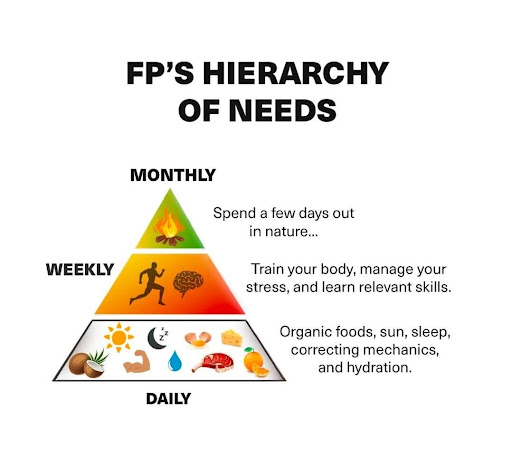
Most people think of training as the time they spend in the gym.
You might train for an hour, three or four times per week, and consider that your exercise done.
But your body doesn't know when your workout starts and finishes.
Every step you take, every position you sit in, every time you pick something up, every meal you eat and every hour you spend indoors is influencing your body.
This is one of the fundamental ideas behind the Functional Patterns approach.
Exercise is something you deliberately do.
Movement is something you do all day.
That distinction matters.
You can spend an hour working on your biomechanics in the gym and then spend the next eight hours sitting (or standing, working, walking etc) in positions that reinforce the exact patterns you're trying to change.
That doesn't mean you need to obsess over your posture or analyse every movement you make.
It means you need to understand that your body is adapting to the totality of your environment and behaviours, not just your workouts. And you need to be aware of how you’re doing things cumulatively throughout the day.
At Functional Patterns Newcastle, our goal is to improve fundamental human movement — particularly standing, walking, running and throwing — while helping you integrate those principles into your everyday life.
The gym is the laboratory.
Life is where you apply it.
The Functional Patterns lifestyle protocols can broadly be divided into four areas:
This includes the way you train, the activities you participate in and how you apply biomechanical principles throughout your day.
The foods and substances you consume influence your energy availability, recovery, body composition and overall ability to perform. Some foods can also be a physical hindrance to improving aspects of your biomechanics.
Your body is constantly responding to environmental signals such as light, darkness, movement, temperature and time spent in nature.
Rather than stopping at symptoms and labels, we want to understand the mechanisms and systems contributing to an outcome.
These four areas aren't independent.
They interact.
Your movement affects your activity.
Your activity affects your energy requirements.
Your diet affects your recovery.
Your environment affects your behaviour.
Your behaviour affects your movement and lifestyle.
It's all connected.
Modern health and fitness culture is very good at selling solutions to isolated problems.
A supplement for energy.
A stretch for tightness.
A program for fat loss.
A treatment for pain.
A gadget for recovery.
Sometimes these things have a place.
But if the underlying system isn't working well, continually adding more interventions can simply mean you're managing the outputs rather than addressing the inputs.
The FP approach is to step back and look at the bigger picture.
How are you moving?
What are you eating?
How are you sleeping?
How much sunlight are you getting?
What activities are you doing repeatedly?
What behaviours are being reinforced by your environment?
What happens when you're not in the gym?
These questions often lead to more useful answers than simply asking, "What exercise should I do?"
For the next week, don't try to change everything.
Instead, observe.
Pay attention to how you:
The first step isn't always intervention.
Sometimes it's simply understanding the system you're currently creating.

