
September 2, 2026
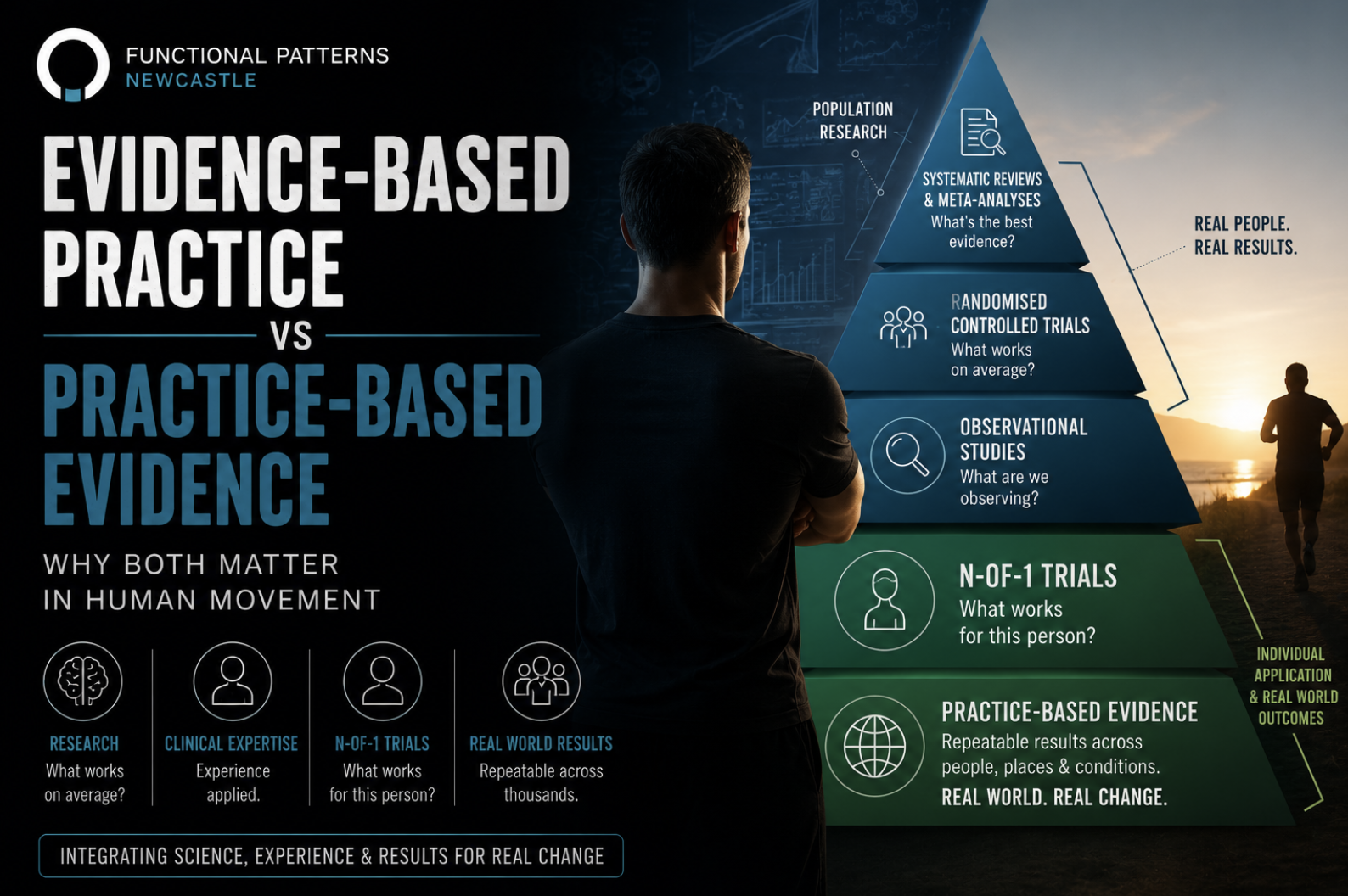
Evidence-Based Practice has transformed healthcare.
Without it, rehabilitation would still rely heavily on tradition and opinion.
But somewhere along the way, many clinicians began equating Evidence-Based Practice with one thing:
Published research.
That was never the original intention.
Evidence-Based Practice was developed to integrate three equally important components:
These three pillars work together.
Research alone was never intended to dictate every clinical decision.
Randomised Controlled Trials are excellent for testing simple questions.
Does intervention A outperform intervention B?
Does changing one variable influence another?
But human movement, and physiology isn't simple.
Pain is influenced by:
Biomechanics.
Psychology.
Stress.
Sleep.
Breathing.
Learning.
Previous injuries.
Environment.
Physical capacity.
These variables interact continuously.
Yet research must deliberately reduce complexity in order to study it.That's both its strength and its limitation.
Many rehabilitation studies exclude participants with:
Researchers need controlled populations.
Clinicians work with real people.
Most clients arrive with several interacting problems that can't be separated into neat experimental groups.
Imagine helping someone with chronic lower back pain.
Would changing only one variable be enough?
Or would lasting improvement require changes in:
Real rehabilitation often requires multiple changes occurring together.
That's difficult to study in an RCT.
But it's everyday clinical practice.
Interestingly, Gordon Guyatt—the physician who coined the term Evidence-Based Medicine—has recently argued that well-designed N-of-1 trials deserve to sit at the top of the evidence hierarchy for individual patient care.
Why?
Because research tells us what tends to work for groups.
An N-of-1 trial tells us what actually works for the individual standing in front of us. Ultimately, that's the question every client cares about.
Functional Patterns is built around this idea.
Every client becomes an ongoing N-of-1 trial.Movement is assessed.
An intervention is applied.
The response is measured.
The programme evolves.
This process has now been repeated across thousands of people from vastly differentbackgrounds:
Children.
Older adults.
Athletes.
Parents.
Office workers.
People with knee pain.
Lower back pain.
Shoulder pain.
Movement limitations.
Neurological conditions.
Across countries, cultures and demographics, remarkably consistent bio-mechanical principles continue producing repeatable results.
That's what Practice-Based Evidence looks like.
At Functional Patterns, research isn't ignored.
It's placed within a broader framework.
Everything begins with first principles.
Human evolution.
Gravity.
Force transmission.
Walking.
Adaptation.
Research investigates those principles.
Clinical reasoning applies them.
Practice-based evidence demonstrates whether they continue working in the complexity of real life.
The future of rehabilitation doesn't belong to research alone.
Nor does it belong to anecdote alone.
It belongs to systems capable of integrating:
That's the philosophy underpinning Functional Patterns.
Not choosing between science and experience.
But recognising that lasting human change requires both.

